How Smash works
Smash is a padel tracker for Apple Watch. You wear the Watch on your racket hand, start a match and play, and afterwards the app shows every shot you hit, how hard you hit it, and a score for the match.
It does this with no camera and no sensor on the racket, and it never sees the ball. All it has is how your wrist moves, fifty times a second. This page shows how it gets from that to a forehand, a volley or a smash.
Here it is at work on a real session. The line is how hard the wrist is accelerating. Each time it rises past the dashed line, Smash captures the swing and names the shot.
The rest of this page takes that apart: what Smash measures, how it notices a shot, how it names it, and how that becomes the speed and the Padel Score you see in the app.
Everything here runs on real recordings: 2,396 swings from 35 sessions by one right-handed player. The page applies the same rules as the app to them. It shows how the watch decides, not how often it is right; that hasn’t been measured yet.
What Smash measures
Three things matter. The first is acceleration: how hard the wrist is being pushed, with gravity taken out, in units of g. A wrist at rest reads zero, and a hard swing can reach ten or more. The second is the tilt of the forearm: level reads 0°, pointing straight up or down reads 90°. The third is how fast the forearm is twisting about its own length, the motion of turning a door handle.
Here is one swing, a second of it, with the moment of contact in the middle. Move over the chart to read the values.
The watch never sees the ball, so “contact” is its own guess: the instant at or just after the peak when the acceleration changes most abruptly, which is what a ball hitting a racket does to the arm holding it.
One swing is an anecdote. Here are all of them drawn on top of each other, lined up on the contact, so that the picture is brightest where the most swings pass.
Switch between the kinds of shot and the shapes change. Overheads carry the forearm high through contact. Volleys barely rise off the floor of the chart. That difference in shape is all the watch has to go on.
How it notices a shot
Most of the time the wrist is doing nothing worth recording: walking, waiting, picking up a ball. The watch waits for the acceleration to cross a line, 1.7 g. When it does, it starts capturing, and it also keeps the 0.6 seconds from just before, because a swing begins well before it gets fast.
It stops when the acceleration has stayed under 1.1 g for a tenth of a second, or after 0.8 seconds, whichever comes first. Then it looks at the highest point in what it caught. At 2.6 g or more, it was a shot. Less than that, and it is thrown away.
Both lines are compromises, and you can feel them with the sliders. Set the start too high and gentle shots are never seen. Set it too low and the watch captures every wave of the hand. The gentle swing in the figure is the difficult case: a soft block at the net barely moves the arm. For those the app has one more rule that this page can’t show, because it needs the full signal: a swing between 1.8 and 2.6 g still counts if it contains the sharp knock of a ball on the racket.
After a swing the watch waits 0.45 seconds before it will start another, so that a follow-through is not counted as a second shot.
How it names the shot
A captured swing is boiled down to a handful of numbers: its peak, how far the forearm was tilted at contact, how far the tilt swept during the swing, how long it lasted, which way the forearm twisted, and how long it had been since the previous shot. Then the watch asks a short list of questions, in a fixed order, and stops at the first one that settles the matter.
The order matters. Overheads are picked out first, by the arm being up, and only then split into bandeja and smash by how hard they were hit. A serve is recognised partly by what came before it: a pause in play. Forehand and backhand come last, and are told apart by a single thing, the direction the forearm twisted. For a left-handed player the app flips that direction.
Where the lines are
Each question is a line drawn through all possible swings. The figure below shows the two that decide an overhead. Every dot is one of the 2,396 swings, placed by how far the forearm was tilted at contact and how hard the swing was. Move the lines and every swing is judged again.
The swings don’t fall into separate groups with gaps between them. They form one cloud, and the lines cut through it. A smash and a bandeja are not two different things to the watch: they are the same overhead on either side of 5.5 g. The lines were placed by hand, from drills in which every shot was known, and moving the smash line by half a g changes the count by dozens.
The speed you see
Right after each shot, your Watch shows a speed, and the match summary on your iPhone shows the hardest one. The watch can’t measure the speed of the ball or of the racket, so this is an estimate made from the peak of the swing alone, with a curve that flattens out: each extra g adds less than the one before, and nothing is ever shown above 125 km/h.
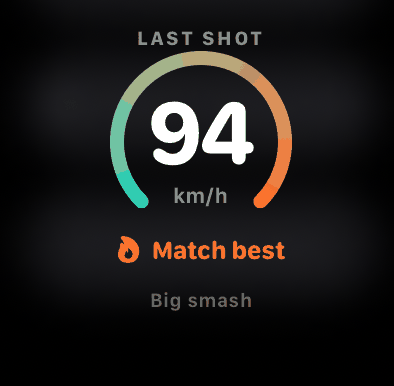
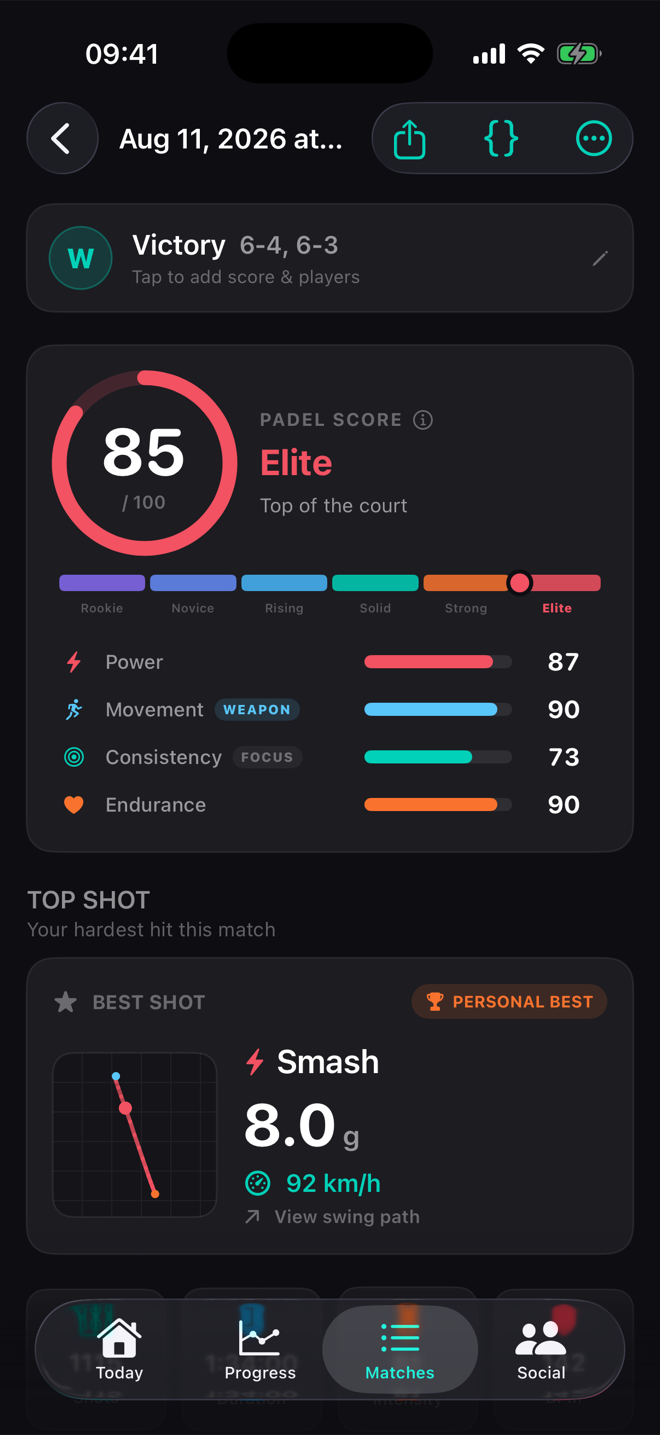
It is best read as a way of comparing your own shots with each other. Two players with the same swing but different rackets, or one who meets the ball better, would be shown the same number.
Your Padel Score
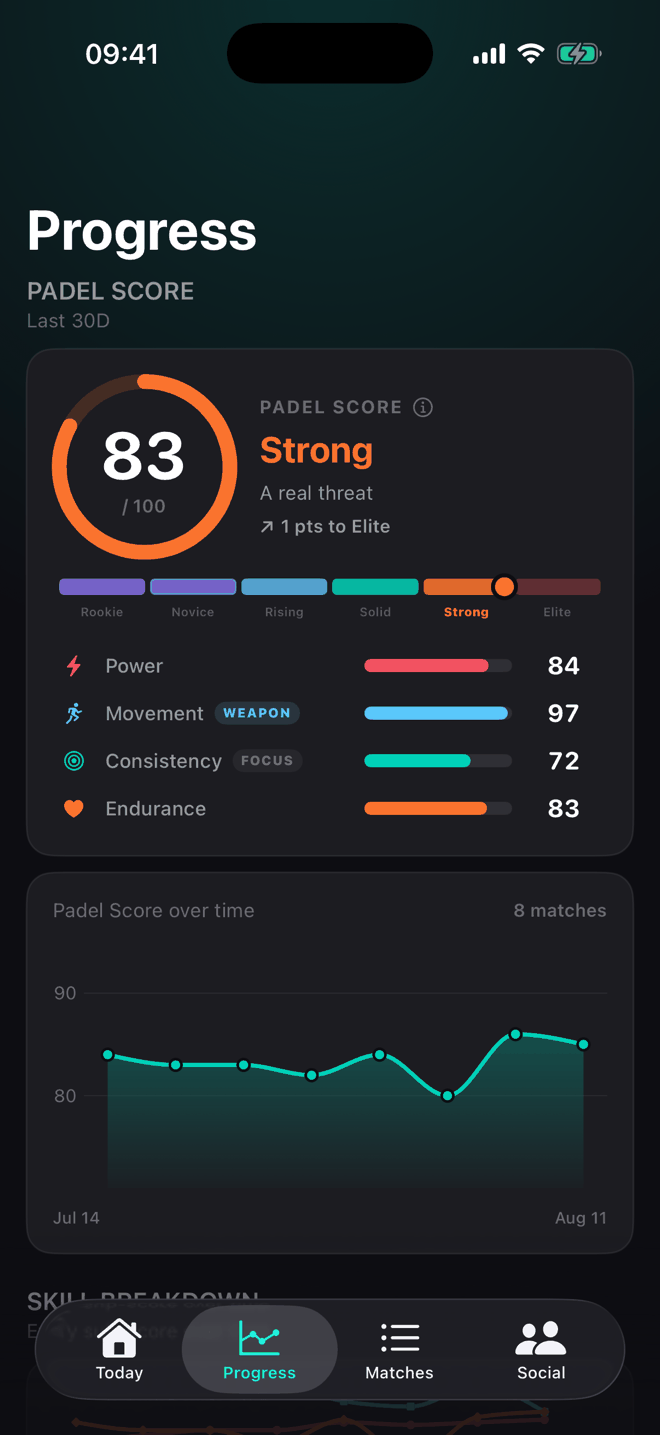
After a match Smash gives you four scores out of 100 and blends them into one, your Padel Score. Each is a mix of a few measurements, and each measurement is compared with what a good club player manages: a hardest shot of 7.5 g, 35 m of movement a minute, six shots in a rally, 90 minutes on court.
Power is 60% your hardest shot and 40% your average one. Movement is half the distance you covered each minute and half the share of the court you visited, both from GPS. Consistency is 60% how even your shot power was and 40% how many shots your rallies lasted. Endurance is half time on court, with the rest from heart rate (30%) and the number of shots (20%). The overall rating is 30% power, 25% consistency, 25% endurance and 20% movement.
Each part stops counting once it reaches its reference, so a 12 g smash earns no more power than a 7.5 g one. That is why moving one slider far to the right eventually stops moving the bars.
What Smash can’t see
A wrist is a narrow view of a rally. The watch doesn’t know whether the ball went in, where it landed, or who won the point. It can’t tell a shot from a practice swing that happens to be hard enough. GPS on a watch is good to about ten metres, on a court that is ten metres wide, so position on the court is a rough guide at best. And every line on this page was drawn by a person looking at data from a few players. The shapes are real; where exactly one shot becomes another is a decision.
Try it on your own game
Everything on this page runs on one player’s swings. Smash is free, and it will do the same with yours.
Download on the App StoreNeeds an Apple Watch on watchOS 26 and an iPhone on iOS 18.6.